
When a patient depends on mechanical ventilation, transportation requires specialized medical equipment, continuous monitoring, and trained healthcare professionals. A standard vehicle or basic ambulance may not be suitable for a patient who needs respiratory support throughout the journey.
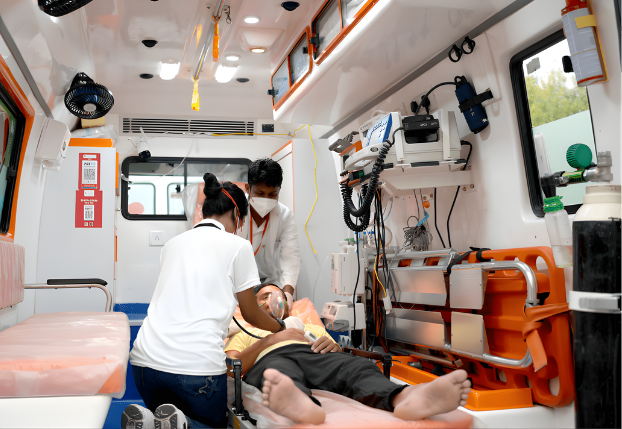
Mahavir Ventilator Ambulance Services provides specialized medical transportation for eligible ventilator-dependent and critically ill patients who require assisted breathing during ground transfers. Our service can be coordinated for hospital-to-hospital transfers, emergency transportation, long-distance journeys, airport transfers, railway station transfers, and other medically supervised movements.
A ventilator ambulance is a specialized ambulance equipped with a portable mechanical ventilator and other critical-care equipment required to support patients who cannot maintain adequate breathing independently.
The ambulance is designed to provide a controlled medical environment during transportation. Depending on the patient’s condition, the transfer may include ventilator support, oxygen, cardiac monitoring, suction, infusion pumps, emergency medicines, and other essential equipment.
The exact setup is determined by the patient’s clinical condition and transportation requirements.
Ventilator-supported medical transportation may be considered for patients who:
Not every ventilated patient is suitable for every type of journey. A medical assessment should be completed before transportation.
Depending on the patient’s needs, a ventilator ambulance may include:
Equipment requirements can vary according to the patient’s diagnosis, ventilator settings, oxygen consumption, and duration of transportation.
For a ventilator-dependent patient, maintaining appropriate respiratory support throughout the journey is a critical part of the transfer plan.
Before departure, the medical team reviews the patient’s ventilator requirements, oxygen needs, vital parameters, medication schedule, and emergency-care requirements. During transportation, the patient can be monitored according to the level of care required.
Adequate preparation is particularly important for long-distance journeys where oxygen and power requirements must be carefully planned.
Ventilator transportation requires personnel who understand respiratory support and critical-care patient management.
Depending on the patient’s condition, the medical team may include:
The appropriate team is selected according to the patient’s clinical needs, travel duration, and required level of intervention.
Ventilator patients may need to move between hospitals for specialized treatment, advanced procedures, intensive-care facilities, or specialist consultation.
Mahavir can coordinate the transfer between the referring and receiving hospitals while arranging the appropriate ventilator ambulance and medical support.
The receiving hospital can also be informed about the patient’s condition and expected arrival to support a smoother admission process.
For patients who cannot safely move independently, minimizing unnecessary transfers is important.
Mahavir can coordinate a complete bed-to-bed journey:
ICU Bed → Ventilator Ambulance → Destination Hospital → Receiving ICU Bed
Ground transportation can also be connected with airport or railway transfers when the patient requires a longer medical journey.
Long-distance road transportation for ventilated patients requires detailed planning. Before departure, the team may evaluate:
The feasibility of a road journey should be determined by the patient’s treating medical team and the transportation provider.
Patients travelling by air ambulance or suitable commercial medical transportation may need a ventilator-equipped road ambulance to connect the hospital with the airport.
Mahavir can coordinate:
Hospital → Ventilator Ambulance → Airport
and, where required:
Airport → Ventilator Ambulance → Receiving Hospital
This creates a connected medical transfer for patients requiring respiratory support.
Patients travelling through a medically supported train transfer may also require a ventilator ambulance between the hospital and railway station.
Such transfers require coordination between the road ambulance team, railway medical arrangements, and receiving hospital.
Mahavir can coordinate ventilator ambulance services across multiple locations in India, subject to ambulance, equipment, medical team, and route availability.
Services may be arranged in cities including:
Patna | Delhi | Kolkata | Ranchi | Guwahati | Lucknow | Varanasi | Mumbai | Hyderabad | Chennai | Bengaluru | Bhubaneswar | Jaipur | Ahmedabad | Pune
Intercity transfers can also be evaluated based on the patient’s medical condition and destination.
The ambulance can be equipped with a suitable portable ventilator and respiratory-care equipment.
Patients can receive continuous monitoring appropriate to their medical requirements.
A qualified medical team can accompany the patient according to the required level of care.
Oxygen requirements can be assessed and planned before departure.
The complete transfer can be coordinated from the patient’s current hospital bed to the destination facility.
For intercity journeys, route, duration, equipment, oxygen, and medical staffing requirements can be considered in advance.
To evaluate a ventilator transfer, the following information is helpful:
Providing accurate medical information helps determine the appropriate ambulance configuration and medical team.
In urgent situations, a ventilator-dependent patient may require rapid transfer to another medical facility. Mahavir can assist with emergency transportation coordination subject to vehicle, medical team, route, and destination availability.
The receiving hospital should be identified in advance whenever possible so that the patient’s admission and critical-care requirements can be coordinated.
Newborns and children requiring respiratory support need specialized medical attention during transportation. Their transfer should be planned according to age, weight, diagnosis, respiratory requirements, monitoring needs, and specialist support.
A neonatal or pediatric transport setup may be more appropriate than a standard adult ventilator ambulance for certain cases.
Some patients require mechanical ventilation following major surgery or intensive-care treatment. If the treating team determines that transportation is medically appropriate, a ventilator ambulance can provide respiratory support and monitoring during the transfer.
The ambulance configuration should match the patient’s post-operative condition and clinical requirements.
Ventilator ambulance transportation involves critically ill patients and requires careful clinical planning. A ventilator alone is not sufficient; the patient’s oxygenation, circulation, airway, medications, monitoring, and emergency requirements must also be considered.
The treating medical team should determine whether the patient is stable enough for transportation and what level of medical support is necessary.
A ventilator ambulance is a specialized medical transport vehicle equipped with a mechanical ventilator and other critical-care equipment for patients requiring assisted breathing during transportation.
Some ventilator-dependent patients can be transported by road when their condition is sufficiently stable and the required equipment and medical team are available. Medical assessment is essential before travel.
Yes. Ventilator ambulances can provide oxygen support appropriate to the patient’s requirements, with oxygen planning carried out before departure.
A doctor or other qualified critical-care professional can be arranged depending on the patient’s medical condition and level of support required.
Yes, selected long-distance transfers can be coordinated based on the patient’s clinical condition, route, travel duration, and ambulance availability.
Yes. Ventilator-equipped road ambulances can be coordinated for airport and railway station transfers when required as part of a larger medical journey.
A ventilator-dependent patient requires specialized attention throughout transportation. Mahavir Ventilator Ambulance Services provides coordinated ground medical transportation with respiratory support, critical-care equipment, trained medical personnel, and bed-to-bed transfer planning.
For a ventilator patient, share the pickup location, destination hospital, current medical condition, ventilator requirement, oxygen requirement, and preferred travel time. Mahavir can help assess the case and coordinate an appropriate ventilator ambulance for the planned medical transfer.