
During a medical emergency, every stage of transportation needs to be coordinated carefully. Mahavir Emergency Transportation Services helps patients, families, hospitals, and healthcare facilities arrange urgent medical transportation when a patient needs to reach an appropriate healthcare facility quickly and safely.
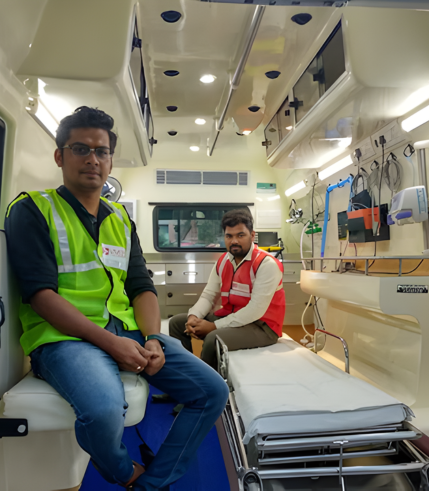
Depending on the patient’s condition, emergency transportation may involve a BLS ambulance, ALS ambulance, ICU ambulance, ventilator ambulance, air ambulance, Train Ambulance or other medically appropriate transport option.
Emergency transportation is designed for situations where delaying medical care may increase risk. The appropriate ambulance is selected according to the patient’s condition, required medical support, travel distance, and destination.
Mahavir can assist with emergency transportation for:
The ambulance level should always match the patient’s clinical needs.
A Basic Life Support ambulance may be suitable for medically stable patients who require basic medical assistance and transportation to a healthcare facility.
An Advanced Life Support ambulance is intended for patients who may require advanced monitoring and emergency medical intervention during transportation.
Patients requiring intensive monitoring or critical-care support may need an ICU ambulance equipped with advanced medical equipment and appropriate healthcare personnel.
Patients dependent on mechanical ventilation may require a specialized ventilator ambulance with respiratory support, oxygen, monitoring equipment, and trained medical professionals.
For selected critical patients travelling long distances, an air ambulance may provide a faster transportation option than an extended road journey. Suitability depends on the patient’s medical condition, route, aircraft availability, and operational factors.
Patients may need urgent transfer from one healthcare facility to another when specialized treatment, advanced equipment, surgery, or intensive-care capacity is required.
Mahavir can coordinate transportation between the referring and receiving hospitals while considering:
For patients with limited mobility or critical illness, a coordinated bed-to-bed transfer can reduce unnecessary movement.
A typical emergency transfer may involve:
Hospital Bed → Medical Ambulance → Destination Hospital → Receiving Bed
Where necessary, road transportation can also be connected with an airport, railway station, or air ambulance for longer journeys.
Critically ill patients may require continuous monitoring and life-support equipment during transportation. An appropriate ICU or advanced life-support ambulance can provide a controlled medical environment for eligible patients.
Depending on the clinical requirement, support may include:
The final equipment and medical team should be determined according to the patient’s condition.
Accident and trauma patients may require immediate transportation to an appropriate hospital. Depending on the severity of the injury, the ambulance may need immobilization equipment, oxygen, monitoring, and other emergency-care facilities.
Families should provide the exact pickup location and available information about the patient’s condition so that the appropriate ambulance can be coordinated.
Stroke patients can require time-sensitive medical evaluation and treatment. If transportation is required, the patient should be moved using an appropriate ambulance based on their condition.
Mahavir can coordinate emergency ground transportation and, when medically appropriate, help arrange a higher-level medical transfer.
Patients experiencing serious cardiac symptoms may require urgent medical evaluation. An appropriately equipped ambulance can provide monitoring and emergency support during transportation.
The receiving healthcare facility should be informed whenever possible so that appropriate medical care can be prepared.
Ventilator-dependent patients require specialized transportation because mechanical respiratory support must be maintained throughout the journey.
Mahavir can coordinate ventilator ambulance services for suitable patients, including critical-care equipment, oxygen, monitoring, and trained medical personnel according to clinical requirements.
When advanced treatment is unavailable locally, an emergency patient transfer to another city may become necessary. Mahavir can coordinate road, rail, or air medical transportation depending on the patient’s condition and travel distance.
For long-distance transfers, the medical team evaluates the patient’s stability, equipment requirements, oxygen needs, and suitability for the selected mode of transportation.
Patients travelling for urgent medical treatment may need ambulance support between hospitals and transportation hubs.
Mahavir can coordinate:
Hospital → Emergency Ambulance → Airport/Railway Station
and:
Airport/Railway Station → Emergency Ambulance → Receiving Hospital
This can help connect different stages of an emergency medical journey.
Mahavir can coordinate emergency patient transportation across multiple cities and regions in India, subject to vehicle, medical team, aircraft or railway availability, and operational conditions.
Services may be arranged in:
Patna | Delhi | Kolkata | Ranchi | Guwahati | Lucknow | Varanasi | Mumbai | Hyderabad | Chennai | Bengaluru | Bhubaneswar | Jaipur | Ahmedabad | Pune
Intercity emergency transfers can also be evaluated according to the patient’s location and destination.
Our team focuses on arranging the appropriate medical transportation as quickly as practical.
Depending on the case, BLS, ALS, ICU, ventilator, road, train, or air ambulance options can be considered.
The selected ambulance can be equipped according to the patient’s clinical requirements.
Appropriate healthcare professionals can accompany the patient when required.
The referring and receiving facilities can be included in the transfer planning process.
Emergency transportation requirements can occur at any time, and assistance is available for urgent coordination.
When contacting Mahavir, provide as much of the following information as possible:
Accurate information helps the team identify the appropriate level of medical transportation.
The fastest transportation option is not always the safest option for every patient. The patient’s medical stability, required support, travel distance, weather, route, and destination facilities should all be considered.
For patients requiring advanced critical care, transportation should be undertaken with appropriate medical supervision and equipment.
Emergency patient transportation is medically supported movement of a patient to an appropriate healthcare facility when urgent medical care or transfer is required.
It depends on the patient’s condition. BLS may be suitable for stable patients, while ALS, ICU, or ventilator ambulances may be required for patients needing advanced support.
Yes. Intercity medical transfers can be coordinated by road, train, or air depending on the patient’s condition and transportation requirements.
Suitable ventilator-dependent patients can be transported using a specialized ventilator ambulance with appropriate respiratory support and medical supervision.
Yes. Ambulance transportation can be coordinated for airport and railway station transfers as part of an emergency medical journey.
Emergency transportation coordination can be requested at any time, subject to vehicle, medical team, route, and destination availability.
When urgent medical transportation is required, proper coordination can help connect the patient with the appropriate healthcare facility. Mahavir Emergency Transportation Services in India assists with emergency road ambulance, critical-care transfers, ventilator transportation, and other medical transport options according to patient requirements.
For urgent assistance, provide the patient’s current location, medical condition, destination, and required level of support. Our team can help coordinate the most appropriate available emergency transportation option.