
When a patient needs medical supervision and additional support during a long-distance journey but does not require a complete intensive care setup, a Semi ICU Train Ambulance can be a suitable patient transportation option. Mahavir Semi ICU Train Ambulance Services helps families and hospitals coordinate medically supported railway transfers across India.
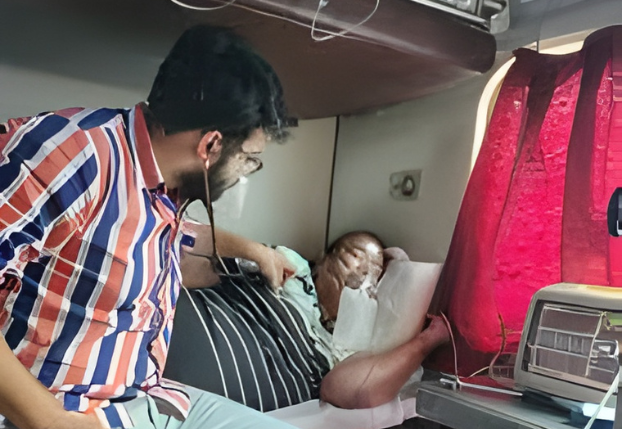
A semi-ICU train transfer is planned according to the patient’s condition, mobility, monitoring requirements, oxygen needs, and duration of travel. The objective is to provide a safer and more comfortable journey while maintaining appropriate medical observation throughout the transfer.
A Semi ICU Train Ambulance is a medically supported railway transportation arrangement intended for patients who require more care than conventional train travel but may not need a full ICU-level setup.
Depending on the patient’s medical condition, the transfer may include a suitable patient bed, oxygen support, monitoring equipment, essential emergency supplies, and a trained medical attendant or healthcare professional.
The exact facilities are selected according to the patient’s clinical requirements and the practical limitations of railway transportation.
Semi ICU train transportation may be considered for patients who:
A medical assessment should be completed before confirming the transfer to ensure that railway transportation is appropriate for the patient’s condition.
Depending on the patient’s requirements, a semi-ICU arrangement may include:
Equipment availability and the level of support are determined according to the patient’s condition and the selected journey.
Long railway journeys can be difficult for patients who have restricted mobility or are recovering from illness. A semi-ICU arrangement can provide a more suitable environment than conventional passenger travel for eligible patients.
The patient can receive assistance with positioning, medication schedules, oxygen requirements, and general medical observation throughout the journey.
Mahavir can coordinate the complete transfer instead of limiting the service to the railway portion of the journey.
A typical transfer may include:
Home/Hospital → Road Ambulance → Railway Station → Semi ICU Train Ambulance → Destination Station → Road Ambulance → Receiving Hospital
Coordinating each stage can help reduce unnecessary handling of the patient and make the overall journey more organized.
Patients who require supplemental oxygen during travel may be considered for semi-ICU railway transportation when their condition is suitable.
Before the journey, oxygen requirements should be evaluated carefully. The medical team can determine the appropriate oxygen arrangement and monitor the patient during transportation.
Patients with high or complex respiratory support requirements may require a higher-acuity medical transport option instead.
A medical attendant can accompany the patient during the journey according to the patient’s needs. The attendant may assist with monitoring, medication, positioning, basic medical care, and communication with the patient’s family.
For patients requiring advanced critical care, a specialized medical team may be more appropriate.
Patients are frequently moved from one hospital to another for specialized consultation, surgery, rehabilitation, oncology treatment, neurological care, cardiac treatment, or other medical services.
Mahavir can coordinate with the patient’s current and receiving hospitals to plan the railway transfer and arrange road ambulance services at both ends.
Mahavir can help coordinate medically supported railway transfers between major Indian cities, subject to route availability and operational feasibility.
Frequently requested routes include:
Other routes can be evaluated based on the patient’s location, destination, railway connectivity, and medical requirements.
Services can be coordinated for transfers involving:
Patna | Delhi | Kolkata | Ranchi | Guwahati | Lucknow | Varanasi | Mumbai | Hyderabad | Chennai | Bengaluru | Bhubaneswar | Jaipur | Ahmedabad | Pune
Availability depends on the selected route, railway arrangements, medical requirements, and travel schedule.
The patient’s condition can be monitored during the journey according to the required level of care.
Medical equipment and oxygen support can be arranged according to clinical requirements and feasibility.
A suitable lying-down arrangement can be more comfortable for patients who cannot travel in a conventional train seat.
Road ambulance services can be coordinated at the departure and destination points.
Medical train transfers can be planned across multiple cities and states in India.
Our coordination team can assist families and hospitals with medical transportation planning at any time.
To evaluate a semi-ICU train transfer, families can provide:
This information helps determine the appropriate medical support and transportation arrangement.
The level of medical support depends on the patient’s condition.
Semi ICU Train Ambulance: Generally intended for patients requiring medical observation, oxygen or basic monitoring, and assisted transportation.
Full ICU Train Ambulance: Intended for patients requiring a substantially higher level of critical-care monitoring and life-support capability.
The appropriate option should be selected after assessing the patient’s clinical condition rather than simply choosing a service category.
A semi-ICU train ambulance is not suitable for every patient. Patients who are unstable or require continuous advanced life support may need a full ICU medical transport or dedicated air ambulance instead.
Before confirming the journey, the patient’s medical condition, required equipment, oxygen needs, travel duration, and availability of appropriate medical personnel should be carefully evaluated.
It is a medically supported railway transportation arrangement for patients who require additional care and monitoring during long-distance travel but may not require a complete ICU setup.
Some patients requiring supplemental oxygen may be suitable for this type of transfer. Their condition and oxygen requirements must be assessed before travel.
Medical staffing depends on the patient’s clinical requirements. A suitable medical attendant, nurse, or other healthcare professional can be coordinated where required.
Yes. Road ambulance transportation can be coordinated between the patient’s home or hospital and the railway station at both ends.
Transfers can be coordinated across many Indian cities, subject to railway routes, availability, medical suitability, and operational conditions.
A long-distance medical journey requires careful preparation, especially when the patient needs assistance during travel. Mahavir Semi ICU Train Ambulance Services in India helps families and hospitals coordinate railway-based patient transfers with appropriate medical support and ground ambulance arrangements.
Contact Mahavir with the patient’s location, destination, medical condition, and travel requirements. Our team can help evaluate the case and coordinate a suitable semi-ICU medical transfer.