
When a critically ill patient needs to travel a long distance for advanced medical treatment, ordinary railway transportation may not provide the medical support required during the journey. Full ICU Train Ambulance Services are designed for patients who need continuous clinical monitoring, advanced life-support equipment, and medical supervision while travelling by train.
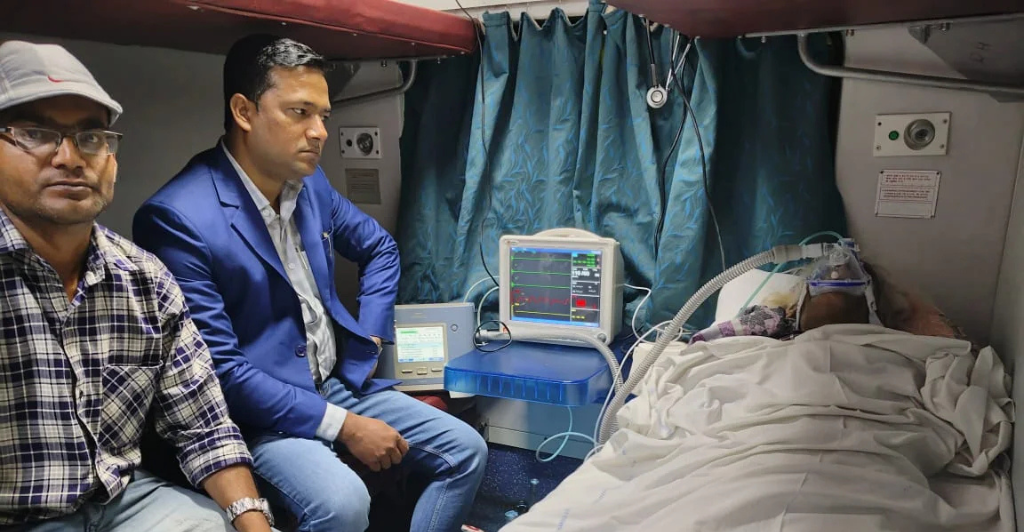
Mahavir provides coordinated ICU train ambulance solutions for intercity and long-distance patient transfers across India. Depending on the patient’s condition, the arrangement can include an ICU-equipped compartment, trained medical professionals, critical-care equipment, oxygen support, monitoring systems, and ambulance transportation at both ends of the journey.
A Full ICU Train Ambulance is a specialized medical transportation arrangement in which a patient travels by train with facilities intended to support intensive medical care during the journey.
Unlike a basic patient transfer, an ICU-level train arrangement is planned around the patient’s clinical requirements. The medical team evaluates the patient’s condition and determines the equipment, medicines, oxygen supply, monitoring, and personnel required for the journey.
It can be considered for patients who are medically stable enough for railway transportation but still require a high level of medical observation and support.
Depending on the patient’s medical requirements and the feasibility of railway transportation, ICU support may include:
The exact equipment package is determined after reviewing the patient’s medical condition and transfer requirements.
Full ICU train ambulance transportation may be considered for patients with conditions requiring close observation during long-distance travel, including:
Not every critically ill patient is suitable for railway transportation. A medical assessment should determine whether the patient can safely undertake the journey.
Mahavir focuses on coordinating the complete patient movement rather than treating the railway journey as an isolated service.
A typical transfer can be organized as:
Hospital/Home → ICU Road Ambulance → Railway Station → ICU Train Ambulance → Destination Station → ICU Road Ambulance → Receiving Hospital
This integrated arrangement can reduce unnecessary transfers and help maintain continuity of medical care throughout the journey.
Some patients depend on mechanical ventilation and require respiratory support throughout transportation. For such cases, advance planning is essential.
The medical team evaluates ventilator requirements, oxygen consumption, monitoring needs, medications, and emergency-care requirements before travel. Suitable portable equipment can then be arranged where the transfer is operationally and medically feasible.
Ventilator-dependent patients require particularly careful assessment because railway transportation may not be appropriate for every clinical situation.
Patients who require supplemental oxygen during travel may need a continuous and carefully calculated oxygen supply. Oxygen requirements can vary depending on the patient’s diagnosis and respiratory condition.
Before departure, the required oxygen capacity, delivery system, monitoring, and backup arrangements should be assessed. The medical team also monitors the patient during the journey and responds to changes in clinical condition.
An ICU-level patient transfer requires trained personnel capable of managing the patient’s condition during a long journey.
Depending on the patient’s requirements, the transfer team may include:
The composition of the team depends on the patient’s diagnosis, treatment requirements, stability, and equipment needs.
Mahavir can coordinate long-distance medical railway transfers connecting major healthcare destinations throughout India.
Commonly requested routes may include:
Patna to Delhi
Patna to Kolkata
Patna to Mumbai
Patna to Chennai
Patna to Bengaluru
Ranchi to Delhi
Kolkata to Delhi
Guwahati to Delhi
Guwahati to Hyderabad
Delhi to Patna
Other routes can be evaluated according to railway connectivity, availability, patient requirements, and destination arrangements.
Medical transfers can be coordinated from or to cities including:
Patna | Delhi | Kolkata | Ranchi | Guwahati | Lucknow | Varanasi | Mumbai | Hyderabad | Chennai | Bengaluru | Bhubaneswar | Jaipur | Ahmedabad | Pune
The availability and exact arrangement depend on the selected route and railway operating conditions.
The transfer is planned around the patient’s medical requirements rather than conventional passenger travel.
Appropriate monitoring and life-support equipment can be arranged based on clinical needs and operational feasibility.
Qualified medical professionals can accompany the patient throughout the journey when required.
ICU road ambulances can be arranged for transportation between the hospital, railway station, and destination hospital.
The complete route is evaluated to create a coordinated medical transportation plan.
Medical transfers may be required at any hour, and our coordination team assists families and hospitals with urgent transportation planning.
To arrange an ICU train ambulance, the following information is generally required:
This information helps the coordination team understand the level of medical support required and determine the most appropriate transportation arrangement.
Hospitals may require patient transfers when advanced treatment, specialist consultation, surgery, rehabilitation, or a higher level of critical care is available at another facility.
Mahavir can coordinate with the sending and receiving hospitals to help organize the medical transfer, including ground ambulance services and onboard clinical support.
A full ICU setup does not automatically make railway transportation suitable for every critically ill patient. Patients with unstable conditions, severe physiological compromise, or requirements beyond what can safely be provided during railway travel may need a dedicated air ambulance or another higher-acuity transportation option.
For this reason, medical assessment should be completed before confirming the transfer. The final equipment and medical team should be selected according to the patient’s actual clinical requirements.
It is a medically supported train transfer designed for patients who require intensive monitoring and selected critical-care support during a long-distance journey.
Some ventilated patients may be transported by train when their condition is sufficiently stable and the required respiratory and medical support can be safely maintained. A medical assessment is essential before confirming the journey.
Medical staffing depends on the patient’s condition and clinical requirements. A suitable medical team can be coordinated for the transfer.
Oxygen support may be arranged when clinically required and operationally feasible. The patient’s oxygen consumption and backup requirements should be assessed before departure.
Yes, ground ambulance coordination can be included for pickup from the hospital or residence and transfer from the destination railway station to the receiving hospital.
Long-distance transfers can be coordinated across many Indian cities, subject to railway connectivity, availability, medical requirements, and operational feasibility.
When a patient requires advanced medical support during a long-distance railway journey, proper planning is essential. Mahavir Full ICU Train Ambulance Services provides coordinated medical transportation solutions for patients requiring intensive monitoring and specialized assistance.
Share the patient’s current location, destination, medical condition, and required support with our team. We can help assess the transportation requirement and coordinate a suitable ICU train ambulance and bed-to-bed medical transfer.