
When a critically ill patient needs to be moved from one medical facility to another, ordinary transportation may not provide the level of care required during the journey. ICU Ambulance Services are designed for patients who need continuous monitoring, advanced medical equipment, and trained healthcare professionals while travelling.
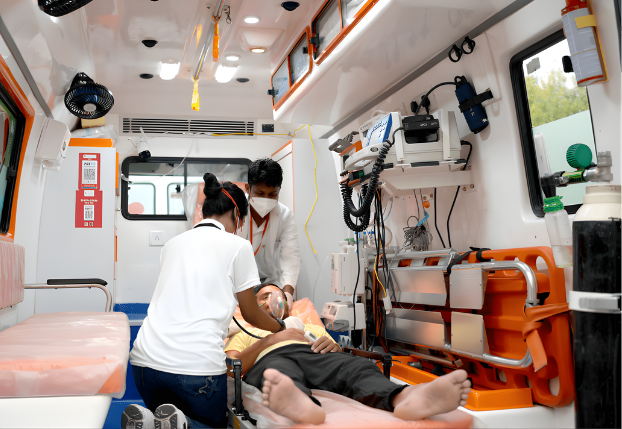
Mahavir ICU Ambulance Services provides coordinated critical-care ground transportation for hospital transfers, emergency patient movement, long-distance medical transfers, airport and railway station transfers, and other situations where intensive medical support is required.
An ICU ambulance is a specially equipped medical transport vehicle designed to provide a higher level of patient care during transportation. It can function as a mobile critical-care environment, allowing eligible patients to receive monitoring and selected life-support interventions while travelling.
The equipment and medical team are selected according to the patient’s diagnosis, current condition, treatment requirements, travel distance, and level of clinical support needed.
Depending on the patient’s clinical requirements, an ICU ambulance may include:
The exact configuration can vary by ambulance and patient requirement.
ICU ambulance transportation may be considered for patients who require continuous medical supervision during movement, including:
The patient’s clinical stability and transportation requirements should be assessed before selecting the ambulance.
Patients who depend on mechanical ventilation may require continuous respiratory support during transportation. An ICU ambulance can be equipped with a portable ventilator and associated monitoring equipment when clinically appropriate.
Before departure, the medical team evaluates the patient’s respiratory condition, ventilator settings, oxygen requirements, medication needs, and emergency-care requirements.
Ventilator transportation should be performed only when the patient is medically suitable for the journey and the required equipment and trained personnel are available.
Patients with significant respiratory requirements may need continuous oxygen during transportation. ICU ambulances can be equipped with appropriate oxygen systems based on the patient’s consumption and clinical needs.
The required oxygen supply, delivery method, monitoring, and backup arrangements should be planned before the journey to help maintain continuity of respiratory support.
An ICU ambulance transfer may require healthcare professionals capable of managing the patient’s condition during transportation.
Depending on the clinical situation, the team may include:
The composition of the medical team is determined by the patient’s diagnosis, acuity, equipment requirements, and duration of transportation.
A common requirement for ICU ambulance services is the transfer of a patient from one hospital to another for advanced treatment.
Patients may be moved for:
Mahavir can coordinate the road ambulance transfer between the referring and receiving hospitals.
For critically ill patients, unnecessary movement should be minimized. A coordinated bed-to-bed transfer can help streamline the patient’s journey.
A typical transfer may follow:
ICU Bed → ICU Ambulance → Destination Hospital → Receiving ICU Bed
Where necessary, ambulance transportation can also be connected with airport or railway station transfers for longer medical journeys.
When air transportation is not suitable or a road transfer is preferred, an ICU ambulance may be considered for long-distance medical transportation.
Long journeys require additional planning for:
The patient’s medical condition should be carefully assessed before undertaking a long-distance road transfer.
Patients travelling through commercial flights, train ambulances, or other medical transportation services may require ICU road ambulance support before or after the journey.
Mahavir can coordinate transfers such as:
Hospital → ICU Road Ambulance → Airport/Railway Station
or
Airport/Railway Station → ICU Road Ambulance → Receiving Hospital
This provides a connected medical transportation plan for patients who require critical-care support.
Mahavir can coordinate ICU ambulance transportation across multiple cities and regions in India, subject to vehicle and medical team availability.
Services may be arranged in:
Patna | Delhi | Kolkata | Ranchi | Guwahati | Lucknow | Varanasi | Mumbai | Hyderabad | Chennai | Bengaluru | Bhubaneswar | Jaipur | Ahmedabad | Pune
Intercity transfers can also be planned based on the patient’s location, destination, clinical condition, and required level of support.
The ambulance can be selected according to the patient’s need for monitoring, respiratory support, infusion therapy, and emergency intervention.
Suitable medical professionals can accompany patients who require a higher level of supervision during transportation.
The service can connect the sending and receiving hospitals for a planned medical transfer.
Ground transportation can be coordinated from the patient’s current bed to the destination facility.
Selected intercity transfers can be arranged with appropriate route and clinical planning.
Critical-care transportation requirements can arise at any time, and Mahavir assists with urgent transfer coordination.
For a proper ICU ambulance assessment, families or hospitals should provide:
Accurate clinical information helps determine the required ambulance configuration and medical team.
In an emergency, timely transportation to an appropriate medical facility can be essential. An ICU ambulance may be considered when the patient requires advanced monitoring or life-support capabilities during the journey.
However, the ambulance type should match the patient’s condition. If the patient is unstable, the transfer should be coordinated with appropriate medical oversight and the receiving hospital.
Some patients require intensive monitoring after major surgery and cannot safely travel in a standard vehicle. An ICU ambulance can provide a controlled medical environment during transportation when the patient’s treating team considers road transfer appropriate.
The medical team can monitor vital parameters and provide required support throughout the journey.
Stroke and cardiac patients may require careful monitoring during transportation. An ICU ambulance can provide appropriate monitoring and emergency equipment for eligible patients.
The patient’s current stability, treatment plan, medication requirements, and destination facility should be considered before transportation.
An ICU ambulance provides advanced medical capabilities, but it does not replace the need for proper medical assessment before transportation.
The treating medical team should evaluate whether the patient is fit for the planned journey and what level of equipment and personnel is required. For some patients, air ambulance transportation may be more appropriate than a prolonged road journey.
An ICU ambulance is a specialized medical transport vehicle equipped to provide intensive monitoring and selected critical-care support during patient transportation.
Yes, ventilator-supported transportation can be arranged for suitable patients when the required ventilator, oxygen system, monitoring equipment, and trained medical team are available.
Yes, intercity and long-distance ICU ambulance transfers can be coordinated based on medical suitability, route, travel duration, and vehicle availability.
A doctor or other appropriate medical professional can be arranged depending on the patient’s clinical requirements.
Yes, ICU ambulances can be equipped with oxygen support appropriate to the patient’s medical requirements.
Yes. ICU road ambulance services can be coordinated for patient pickup or drop-off at airports and railway stations.
When a patient requires intensive medical support during ground transportation, choosing an appropriately equipped ambulance is essential. Mahavir ICU Ambulance Services provides coordinated critical-care transportation for hospital transfers, emergency movement, long-distance journeys, and connected airport or railway transfers.
Share the patient’s pickup location, destination, medical condition, oxygen or ventilator requirement, and preferred travel time with Mahavir. Our team can assess the transportation requirement and coordinate an appropriate ICU ambulance and medical support.