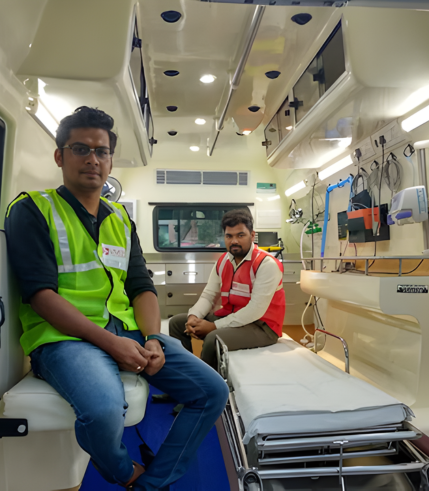
When immediate hospital transportation is required, an ambulance can provide a more suitable option than ordinary private transport. Ambulance arrangements may be made from residences, hospitals, clinics, nursing homes, diagnostic centres, and other locations in Rajendra Nagar.
The service can support transportation for medical emergencies, sudden illness, injuries, post-operative movement, specialist consultations, and hospital referrals.
For proper coordination, callers should provide the patient’s condition, pickup point, destination, mobility status, and any equipment or medical assistance required.
Specialized Ambulance Options
ICU Ambulance for Critical Patients
Patients requiring intensive medical observation during a journey may need an ICU ambulance. Depending on clinical requirements, the setup can include advanced monitoring equipment, oxygen systems, ventilator facilities, and other critical-care resources.
BLS Ambulance for Stable Patients
A Basic Life Support ambulance can be considered when a patient requires medical assistance during transportation but does not require full intensive-care support. It may be useful for hospital visits, transfers, and medically supervised transportation.
ALS Ambulance for Advanced Medical Support
Advanced Life Support transportation is designed for patients who may require a higher degree of medical supervision while travelling. The available equipment and personnel can be matched to the patient’s medical needs.
Ventilator Ambulance
Patients dependent on mechanical ventilation require specialized transport planning. A ventilator-equipped ambulance can be arranged with appropriate respiratory support and qualified medical personnel where required.
Oxygen Ambulance
Patients who need supplemental oxygen while travelling can be transported using an oxygen-supported ambulance. The required oxygen support should be communicated before the ambulance is dispatched.
Stretcher Patient Transportation
For patients who cannot walk or sit comfortably, stretcher-based ambulance transportation can provide safer movement between a residence, hospital, clinic, or diagnostic facility.
Hospital Transfer Service from Rajendra Nagar
A patient may need to be shifted to another hospital because of specialist treatment, surgery, advanced diagnostics, ICU availability, or a referral from the current doctor.
Ambulance transportation can be arranged for:
- Hospital-to-hospital transfers
- Nursing home-to-hospital movement
- Home-to-hospital transportation
- Hospital-to-home discharge transfers
- Transfers to specialized treatment centres
- Diagnostic and treatment appointments
The patient’s medical condition should be communicated before the transfer so that suitable transportation support can be arranged.
Long-Distance Ambulance from Rajendra Nagar
Medical treatment is not always available at the nearest hospital. Patients from Rajendra Nagar may require transportation to other cities for specialized healthcare.
Long-distance ambulance journeys can be planned to destinations such as Patna, Muzaffarpur, Gaya, Ranchi, Kolkata, Delhi, Lucknow, or other healthcare centres.
For longer journeys, factors such as patient stability, travel duration, oxygen dependency, monitoring needs, and requirement for medical staff should be considered before selecting the ambulance.
Train Ambulance Support
For certain patients, travelling by train may be a practical option for a long-distance medical transfer. Train ambulance arrangements can provide medical assistance during the railway journey for patients who are considered suitable for rail transportation.
Planning may include patient handling, medical equipment, accompanying medical personnel, and coordination at the departure and arrival points.
Air Ambulance Assistance
When a patient requires rapid transportation over a considerable distance, air ambulance transfer may be evaluated. Such transfers can involve a medical team, in-flight equipment, airport coordination, and ground ambulance connectivity.
Air medical transportation should be planned according to the patient’s clinical condition, urgency, destination, and medical clearance.
Ambulance for Elderly, Disabled & Bedridden Patients
Patients with limited mobility may need additional support during boarding and transfer. Ambulance transportation can help move elderly, disabled, and bedridden patients using appropriate stretcher or assisted-transfer arrangements.
This can be useful for:
- Routine medical consultations
- Diagnostic examinations
- Follow-up treatment
- Physiotherapy visits
- Hospital admission
- Hospital discharge
- Intercity medical transfers
Medical Transportation for Planned Journeys
Ambulance services are not limited to emergencies. Families can also arrange transportation in advance for scheduled medical appointments and planned hospital transfers.
Advance booking can be particularly useful when a patient requires a specific ambulance type, medical equipment, or accompanying healthcare professional.
Why Choose Ambulance Service in Rajendra Nagar?
- Emergency and pre-planned medical transportation
- 24/7 ambulance booking assistance
- BLS and ALS ambulance options
- ICU ambulance facilities
- Ventilator and oxygen support
- Stretcher-based patient transportation
- Hospital-to-hospital transfers
- Local and intercity patient movement
- Long-distance ambulance arrangements
- Train ambulance coordination
- Air ambulance coordination
- Support for elderly and mobility-limited patients
How to Arrange an Ambulance in Rajendra Nagar
Before booking, keep the following patient information ready:
- Current medical condition
- Exact pickup location
- Destination hospital or medical centre
- Patient mobility status
- Oxygen requirement
- Ventilator requirement
- Stretcher requirement
- Need for medical personnel
- Preferred departure time
- Approximate journey distance
Providing accurate information helps determine the appropriate ambulance configuration.
Rajendra Nagar Ambulance Service for Different Medical Situations
Whether the requirement is an urgent hospital visit, a scheduled medical appointment, an ICU transfer, or an interstate patient journey, the ambulance should be selected according to the patient’s condition.
A suitable medical transportation arrangement can reduce logistical difficulties for families and provide the patient with an environment more appropriate for their medical needs during the journey.
Frequently Asked Questions
Is ambulance service available 24 hours in Rajendra Nagar?
Emergency and scheduled ambulance transportation can be requested at any time, subject to vehicle and medical-support availability.
Can I book an ICU ambulance from Rajendra Nagar?
Yes. An ICU-equipped ambulance can be requested for patients requiring intensive medical support during transportation.
Do you provide ventilator ambulance service?
Ventilator-equipped transportation may be arranged for patients who require mechanical ventilation during their journey, depending on the required medical setup.
Can an ambulance take a patient from Rajendra Nagar to another city?
Yes. Long-distance patient transportation can be planned to other cities according to the patient’s condition, destination, and required medical support.
Is hospital-to-hospital transfer available?
Yes. Ambulances can be arranged for transfers between hospitals, nursing homes, clinics, and specialized healthcare centres.
Can bedridden patients be transported by ambulance?
Yes. Stretcher-based transportation can be arranged for patients who cannot walk or travel comfortably in conventional vehicles.
Can train ambulance service be arranged from Rajendra Nagar?
Train ambulance arrangements may be available for suitable patients requiring long-distance railway transportation, subject to medical suitability and planning.
What information should I provide while booking?
Share the patient’s medical condition, pickup location, destination, mobility status, oxygen or ventilator requirement, and preferred travel time.
Book Ambulance Service in Rajendra Nagar
The right ambulance depends on the patient’s medical condition and the type of journey involved. Ambulance Service in Rajendra Nagar can support requirements ranging from basic patient transportation to BLS, ALS, ICU, ventilator, oxygen, hospital transfer, long-distance road, train ambulance, and air ambulance coordination.
For urgent medical transportation, provide complete patient and destination details so that the appropriate ambulance support can be arranged efficiently.